The Keepsake Box Mistake: Saving Objects Without Saving Their Stories
A keepsake box preserves objects, but a brief note can preserve who gave them, where they came from and why they mattered before those details fade.
The most common keepsake-box mistake is saving an object and assuming its meaning will stay attached. A ticket stub, chipped cup or folded note can outlast the memory of who chose it, where it came from and why it mattered. A keepsake box protects the thing; a few lines of context protect the story that makes it worth keeping.
Why can an object lose its meaning in storage?
Objects are vivid prompts, but they are not complete records. A brooch may bring back a familiar face without recalling whether it belonged to a grandmother, a neighbour or a friend. A small key may look significant and still leave its owner unable to name the door it opened.
Memory fills gaps for a while. Later, those gaps can be filled by guesses: the wrong occasion, a borrowed anecdote, or a story attached to a similar object. Even a label saying “Mum’s” may be too thin to distinguish a gift from an inheritance, or a treasured possession from something kept for convenience.
This is why preserving an object and preserving its meaning are different tasks. The first is physical care. The second is recording the links between the object, its people, its place and its use. Both can matter, but they do not happen automatically together.
What should a keepsake note capture?
A useful note need not read like a family history. It should make the object legible to someone who was not there, including your future self. Start with details you can state plainly, then add the human connection that turns description into memory.
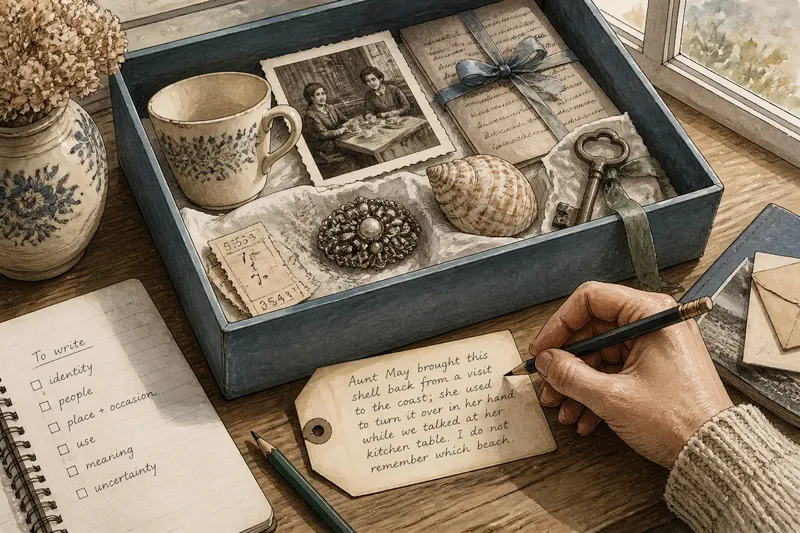
- Identity: What is the object, and what material or visible feature makes it recognisable?
- People: Who owned it, gave it, made it or used it?
- Place and occasion: Where did it come from, and what was happening around it?
- Use: How did it fit into ordinary life? Was it worn, displayed, carried or brought out for a particular occasion?
- Meaning: What do you remember feeling, noticing or valuing about it?
- Uncertainty: Which detail is a firm memory, and which is only a possibility?
Not every object needs every answer. A few accurate particulars are more useful than a polished paragraph built on assumptions. If the date or name is unclear, say so. “Possibly bought on the seaside trip; I remember it was in the blue suitcase” preserves the boundary between recollection and certainty.
How can you record a story before it fades?
Keep the process small enough to do while sorting. Place a pencil and archival paper beside the box, or use a phone’s voice recorder if speaking is easier than writing. A digital note can be copied into a folder named for the object; a paper tag can be stored alongside it rather than tied around a delicate surface.
Begin with the object in front of you. Describe what you can see, then ask yourself what scene returns. A short account might mention the kitchen table where a recipe card was used, the person whose handwriting is on it, and the dish it helped make. Those details give a later reader a setting, a relationship and a reason for the card’s presence.
Say you find a smooth shell in a tin and remember that your aunt kept it near the window. You could write, “Aunt May brought this shell back from a visit to the coast; she used to turn it over in her hand while we talked at her kitchen table. I do not remember which beach.” The note saves the association without pretending to know the missing place.
When someone else knows the story, ask them to speak in their own words. Record their name and how they are connected to the object. You do not need to turn the conversation into an interview: one remembered detail, a place and a person may be enough. If the account conflicts with yours, preserve both versions rather than quietly choosing the tidier one.
Which details are worth keeping—and which are not?
Context helps with a decision, not only with storage. Once you know an object’s story, you can ask whether the physical thing needs to stay. Perhaps the story is precious but the object is fragile, duplicated or difficult to care for. A photograph paired with a note may carry enough of the memory; in another case, the material object may be central because it was handled, worn or made by someone you love.
Try separating three questions: Does this object have a story I want to retain? Do I need the object itself to remember that story? Can I care for it without making it a burden? These questions leave room for different answers. Keeping everything is not the same as honouring everything.
It is not worth the effort to catalogue every ordinary possession as though it were a museum collection. A note is most useful where names, occasions or family connections are likely to become unclear. Skip elaborate labels, decorative binders and elaborate digital systems if they make you postpone the simple act of writing down what you know.
What do people ask about keepsake box stories?
What should I write on a keepsake label?
Write a clear name for the object, the person or people connected to it, and one sentence about its context. Add a question mark or a phrase such as “I think” where a detail is uncertain.
Should I write directly on the object?
No; keep ink, adhesive and string away from a surface that could be marked or damaged. Put the note in a separate envelope or use a suitable tag, following care guidance for the material where needed.
Can a photograph replace the keepsake?
A photograph can preserve appearance, but it rarely records use, touch or the full story by itself. Pair it with a note or voice recording if the object is leaving your home and its context matters to you.
What if nobody remembers the object’s history?
Record what is visible and what you know, then name the gaps instead of inventing a likely story. You can still decide whether the object earns a place in the box based on your present connection to it.
How can the note stay connected to the object?
Choose a simple system you will recognise later. Put a numbered paper slip beside the object and keep a matching note in the same box, or store a photograph and text file together in a clearly named digital folder. Avoid relying on a phone gallery full of unnamed images; a picture called “IMG” may be as mysterious as the object itself.
For delicate items, keep the written account separate from the object and avoid placing paper where it could transfer ink or trap moisture. Care needs differ by material, so follow the maker’s or a conservator’s guidance when preservation questions matter. The story can be stored safely without touching the keepsake.
Revisit the box when a family member can add a detail, or when a note’s shorthand no longer makes sense. Add a dated addition rather than rewriting an older recollection as if it had always been certain. That small distinction lets the story grow while keeping its earlier voice intact.
A keepsake box becomes more than a container when each important object has enough context to be recognised and understood. Before putting the lid on, ask whether someone else could tell what the item is, whose life it touched and what remains uncertain. That modest check turns a keepsake box from a collection of unexplained things into a record of relationships—and makes the keepsake box mistake easier to avoid.