From Calling Card to Open Door: The Changing Idea of a Social Visit
Explore how the calling card shaped formal visits, what it signalled, and how to read the customs behind different kinds of social calls today.
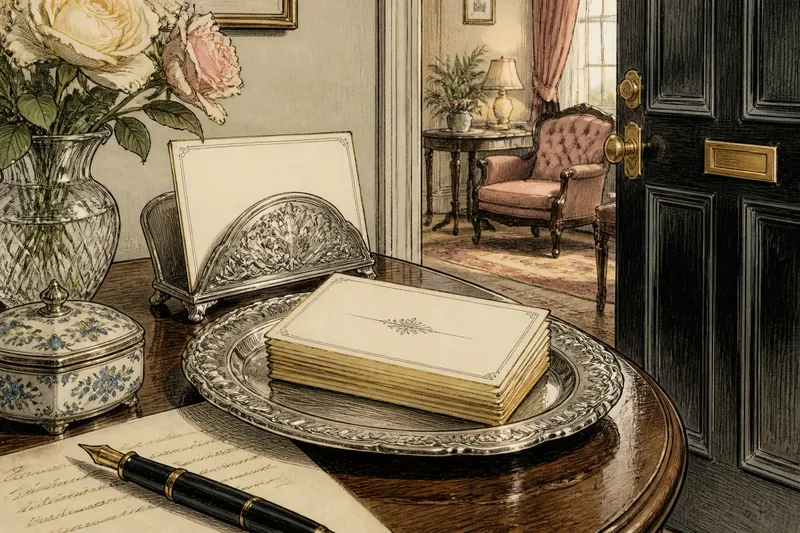
The common mistake is to imagine a Victorian calling card as a quaint prop for an ordinary visit. In nineteenth-century Britain, it belonged to a more formal code: a caller could leave a card when nobody was available, making the visit known without asking to be received. That distinction helps explain how the social call worked—and why its customs do not map neatly onto an informal drop-in today.
What did a Victorian calling card signal?
Among the British middle and upper classes, calling cards helped organise social introductions and visits during the nineteenth century. Their use varied with household, region and period; they were not a universal custom followed in the same way by everyone.
A caller might present a card to a servant or leave it at the house if the person they sought was out. The card identified the visitor and recorded the call. It did not, by itself, require the household to receive them or promise a conversation.
That made the card part of a wider etiquette, rather than a decorative accessory. The caller’s timing, the household’s response and the nature of the relationship all mattered. In a society where servants often managed the threshold of a well-to-do home, the card could pass through that layer of domestic life without turning a brief social gesture into an extended visit.
How did the formal call work?
A formal call was usually a short visit made according to local and social expectations. The caller might be received in a parlour or another room used for visitors, rather than moving through the private parts of the house. If the household was unavailable, leaving a card could still acknowledge the connection.
The ritual gave the encounter a recognisable shape. A host could receive a caller, exchange civil conversation and bring the visit to a close. The caller, in turn, was not automatically entitled to stay for a meal or spend the afternoon there.
Calling-card etiquette could be intricate, and its details changed across settings. There is little value in treating every printed rule as a single national code. The broader point is more grounded: the card helped communicate who had called and whether the household had been able to receive them.
What changed as visits became less formal?
There was no single moment when the formal call gave way to the casual visit. The pace and form of social change differed across communities and households. Over time, however, written notes, telephones and later messaging offered other ways to arrange contact, while social expectations around visiting also shifted.
The setting could change with the relationship. A caller received in a designated parlour met a household’s public-facing side; a friend invited into a kitchen might share a more ordinary stretch of domestic life. Neither room proves a particular degree of intimacy, but each can suggest how a household chooses to receive someone.
Informality is not the absence of custom. It often relies on shared habits instead of a visible ceremony: whether a friend usually texts first, whether neighbours knock without warning, or whether a visit means a quick cup of tea. These habits are local to the people involved, not rules that apply everywhere.
How can you read a social visit today?
Think of a visit in terms of its setting and the signals people have actually shared. A planned meal, a doorstep greeting and an established neighbourly drop-in are different kinds of contact; none is automatically more sincere than another.
- If the invitation names a meal or activity, treat that as the visit’s shape; if it is vague, ask what the host has in mind rather than assuming a long stay.
- If the household has agreed that friends may drop in, follow that shared custom; if you do not know whether it exists, send a message before setting out.
- If a host mentions a task they need to return to, take it as a cue to wrap up; if you cannot tell whether they are ending the visit, ask whether they need to get on.
- If a caller leaves a card or note, read it as a record of contact; if a reply is needed, respond through an appropriate channel rather than treating the card as a demand for an immediate reception.
- If the visit is in a shared home, check that the arrangement suits the other residents too; if it does not, suggest meeting elsewhere or choosing another time.
- If you are hosting and need to leave at a set point, say so when arranging the visit; if plans change, tell your guest plainly instead of relying on hints.
Imagine you have just moved into a British terraced street and want to introduce yourself to the neighbour next door. You begin with the concrete fact that you have not yet met, rather than assuming that an open door means an open invitation. You write a short note asking whether they would like to have tea on Saturday, and add that a brief hello would suit you too. If they accept, you agree on the visit’s basic shape; if they decline, you have made contact without arriving unannounced. The result is a clear introduction, not a claim that one style of visiting is right for every street.
What do people ask about calling cards and visits?
Were calling cards used only in Britain?
No. Calling cards appeared in different societies, with customs that varied by place and period. This account focuses on British middle- and upper-class practice rather than suggesting one universal etiquette.
Did leaving a card mean the caller had been received?
No. A card could record that someone had called even when the person they sought was unavailable. It signalled contact, not necessarily a conversation or an invitation to return.
Is an unannounced visit rude?
Not in every household: some neighbours and friends share an established drop-in custom. If you do not know that the custom exists, contact the person first or choose a public meeting place.
What is the modern equivalent of a calling card?
There is no exact equivalent, but a brief note or message can identify the person and explain the reason for getting in touch. Unlike a card left at the door, a message can also ask whether a visit would suit.
Which parts of the old ritual are worth keeping?
Recreating the furniture, card stock or polished parlour is not worth the effort unless you enjoy the history for its own sake. The more useful detail is how the card separated the fact of making contact from the expectation of being welcomed inside.
That distinction still helps explain the social visit. The calling card belonged to a particular British etiquette, not to every household or every era; today, the best way to understand a visit is to pay attention to the custom shared by the people involved.